The Case for Frolic
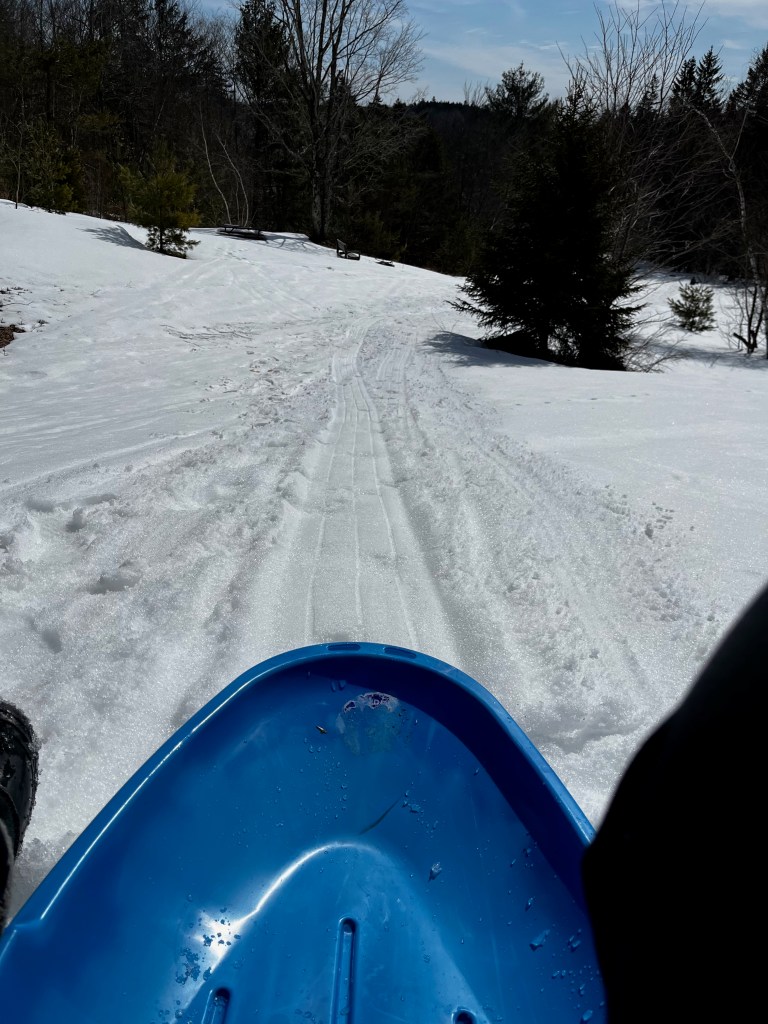
I was looking at old photos of snow days today. Now that my kids are older, I find that I miss sledding. It’s that specific New England mix of family connection and having my own experience. It also brings the slight terror of careening down a hill as a breadwinner who really couldn’t afford an injury.
Those afternoons also took me out of whatever work pressure was looming and gave me a chance to be grounded. Literally, and usually flat on my back, looking up at the blue winter sky.
I think of this as “Frolic.”
It’s fun that requires all of you, both physically and mentally. It doesn’t call for special skills or the latest equipment. It’s the ultimate equalizer. A frolicking 12-year-old and a CEO look exactly the same doing it.
Here’s what I see: It is too easy to write this off as “unserious.” But from a strategic standpoint, we have this backward. The lack of experiences like frolic is causing us harm.
When we deprioritize organic, genuine enjoyment, we don’t just “miss out on fun.” We magnify the stress around us. We leave ourselves poorly equipped to manage the challenges and mismatched systems we face daily.
There is a reason why it feels good to laugh. Your biology rewards you for it, releasing endorphins, lowering cortisol, and creating a sense of protection.
Make a pivot toward frolic. If your plan for success has no room for the equivalent of an afternoon on a sledding hill, your plan needs a redesign. That way is not working, and now is the time to try something new.
Make This the Year You Take Burnout Off the Table
How can I keep this up?
Life drives itself and pulls you along. You prioritize what’s responsible, efficient and expected, assigning bonus points if it’s for someone else. You’re wondering if you’re turning into a machine.
Then comes the breaking point: I can’t do this anymore.
The house of cards falls around you. Responsibilities and stress reach their limit. You’re working to exhaustion but feel like you’re going nowhere. You don’t recognize yourself.
Eventually, you make it out of the woods and start rebuilding your energy. Truly committing to yourself still feels hard, but you’re trying. You’re afraid overwork is your default and burning out is inevitable.
If you feel like this, you’re not alone.
Why Burnout is a Bad Deal
No matter how you look at it, burnout is a bad deal. It leaves you stuck in the mud before it sends you to get professional help.
We are working in a time of tremendous change and uncertainty and within systems that fall short. The last thing you need is for burnout to take away your ability to navigate this era.
Burnout happens in your body, in your mind and in the conference room. It really shows up on the group chat. When you’re exhausted, cynical and feeling like anything you do amounts to nothing, you’re far less able to be strategic, patient, nimble and creative.
And for the few hours a week you’re actually not thinking about work, burnout takes what’s rest. Your quality of life is nowhere near what you want.
Here’s What to Do
If you’re feeling the weight of burnout or fear it’s inevitable, here’s what to do:
Decide burnout is not for you. If you do only one thing, do this. Yes, it’s complicated, but you can take charge of what happens next. Focus this year on preventing burnout. Don’t waste time worrying about it or thinking it’s inevitable.
Talk about how you’re feeling. Even your closest circle won’t know you’re cracking unless you say something. Be specific about your feelings with people who can and want to help.
Get help, the earlier the better. With the right help, better choices become easier and self-preservation becomes normal. You learn to sustain yourself and your energy, no matter what life throws at you.
A Worthwhile Resolution
Make this the year you take burnout off the table. Not as something to fear or manage, but as something you actively prevent through the choices you make every day.
You deserve better than running on empty. Your work deserves better. The people who depend on you deserve better.
And most importantly, preventing burnout gets you out of survival mode. With the right skills and practices you’re able to show up as your best self in an era that demands strategic thinking, creativity and resilience.
The question isn’t whether you can afford to prioritize this. It’s whether you can afford not to.
In my own journey through the embers of burnout, I turned to this verse from the Irish philosopher and mystic John O’Donohue. I have it written in my daily journal and still turn to it for inspiration. I hope it helps you too.
May I have the courage today to live the life I would love. To postpone my dream no longer but do at last what I came here for.
O’Donohue, John. To Bless the Space Between Us: A Book of Blessings. New York: Doubleday, 2008
